Dupuytren's disease
What is Dupuytren's disease?
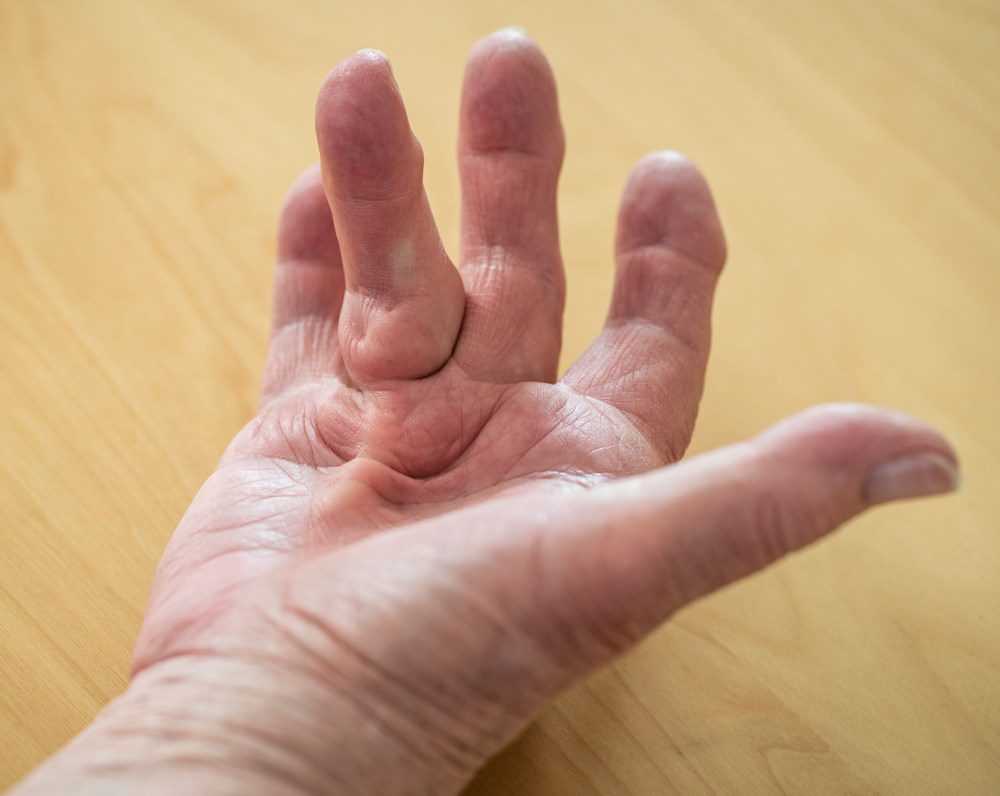
Also known as Vikings disease: it is caused by thickening of the connective fibers in the palm of the hand (palmar fascia), which forms a strong cord like structure that pulls on the fingers.
Over time, the fingers bend and are unable to straighten.
Dupuytren's is usually not painful but can place the fingers in an uncomfortable or less functional position.
What are risk factors for developing Dupuytren's disease?
- Genetics: familial predisposition; higher prevalence in people of northern European descent.
- Age and sex: more frequent in patients older than 40 and males.
- Medical conditions: such as diabetes & smoking.
- Trauma: can appear or progress after a trauma to the hand.
Can Dupuytren's affect other organs?
It can affect feet (Ledderhose); perineal area (Peyronies) and can be associated with a higher risk of shoulder capsulitis.
It does not affect internal organs.
Does it progress quickly?
It is usually slow to progress in most patients, however in some patients with risk factors or strong family history, the flexion of the fingers can happen quickly.
Different treatment options exist for Dupuytren's disease depending on the severity of the finger flexion and the location of the diseased cord:
- Percutaneous or needle aponeurotomy - minimally invasive procedure under local anesthesia.
- Open fasciectomy - performed either under local anesthesia or regional anesthesia, useful in more severe or extensive cases.
- Digit widget + fasciotomy - useful when the small joints of the little finger are bent more than 90 degrees
- Radiation therapy - sometimes offered to decrease recurrence risk in severe Dupuytren's disease or to slow the progression in patients with risk factors.
Can it come back?
Unfortunately, there are no long-term curative treatments for Dupuytren's.
However, in some patients it doesn't come back in the same area, and in many patients the disease progresses slowly.
Most patients have significant improvement in function after treatment.
It is usually slow to progress in most patients, however in some patients with risk factors or strong family history, the flexion of the fingers can happen quickly.
Different treatment options exist for Dupuytren's disease depending on the severity of the finger flexion and the location of the diseased cord:
- Percutaneous or needle aponeurotomy - minimally invasive procedure under local anesthesia.
- Open fasciectomy - performed either under local anesthesia or regional anesthesia, useful in more severe or extensive cases.
- Digit widget + fasciotomy - useful when the small joints of the little finger are bent more than 90 degrees
- Radiation therapy - sometimes offered to decrease recurrence risk in severe Dupuytren's disease or to slow the progression in patients with risk factors.
Can it come back?
Unfortunately, there are no long-term curative treatments for Dupuytren's.
However, in some patients it doesn't come back in the same area, and in many patients the disease progresses slowly.
Most patients have significant improvement in function after treatment.
Most patients have significant improvement in function after treatment.